


When it comes to relationships we generally tend to make our opinions of somethings based on what people said. However, we all know from experience that second-hand information can be distorted and usually convoluted by the person who is conveying it.
Trust can be handled if you know how
When I was young maybe 10 years of age, our English teacher played a fun game with us kids. She had all the kids about 20 of them lined up and would whisper into the ears of one of the kids at the end. That kid needed to whisper the same thing that the teacher had said to the kid next to him/her. Once the message got to the last kid in the line he had to say loudly what he heard. We would all burst out laughing when the teacher would actually tell us the short sentence that she whispered to the first kid. It was amazing to see how the original message go so distorted. Occasionally the first kid would even pick up the message incorrectly from the teacher, it was not that she was trying to make it sound inaudible or anything.
The example above just goes to show that messages get distorted when passed from one person to another. The motto of this example is that you can never know the complete truth until you have first hand experience of it. Have you noticed how people convey information about a movie they have just watched and when you get to see it, you feel that the person had left the most important information out of it? The same is true of when people come to you and talk about anything, it is always colored with their personality and event factual statements may be distorted. This is where witnesses in courts always seem to be in loggerheads in discussing about the events they witnessed.
Take another real example. A person entrusts family members around her to give information related to some assets held in another country. So the person becomes completely and entirely dependant on the individual for the information related to their assets. It would be very easy for the individual if they so wished, to somehow ‘manipulate’ the information that is passed onto the family member. In reality the person who is receiving this information may never get the truth to the information that is being handed down to them because it is being ‘controlled’ by the person who is delivering it. These kind of miscommunication or mistrust often results in dissolution of businesses, breakup in relationships, mistrust in people and much cause for conflicts between people.
One of the endearing quality that some of us have, is that we tend to make the assumption that everyone else tends to think or behave in the same way we do. Many folks go through disillusionments and eventually wake up to the realization that people are just different to them. Trust is such an important quality for all of us to work together in pursuit of greater goals in life. There are people amongst us who take trust to their advantage like the example given previously but one can also lay some blame to the person who completely entrusted the person for that information. In life one has to be aware of good and bad and this can be easily blinded by faith and trust in others that bring about so much frustrations, headaches and often heartbreaks in our lives.
Is there are simple solution that people can follow that will enable them to detect the good from the bad or the bad from the good? Unfortunately, every issue/event that comes across in our lives are different and the way we handle it can develop trust or resentment in others. One cannot be on ‘guard’ all their lives otherwise the whole living thing becomes a ‘chore’ rather than something to look forward to. Next time you become critical of someone that you have crossed paths with, ask yourself how this could have been avoided. This could be a good starting point in maintaining your sanity with people around you and learning how to deal with them and making yourself even better prepared to take on the world.
Brought to you by…
Jumpdates ThinkTank Labs
Tags: dealing with trust, first hand info, miscommunication, second hand info, trust
Many folks take the internet for granted and they happily open up their browsers and go hunting for cheap online fares. What you don’t know and not always astute to is the ways browsers and websites interact with each other and they can paint a different picture when it comes to pricing.

Airline fares accurate? - use of browser cookies
For example, let’s say you went to these online airfare checker sites and they are many of these and you decide to look up fares but have not decided. You will most likely see the fares change with each day. However, the question is, are the fares a reflection of the market movement in prices or because the website knows you through your cookies when you come and visit the site.
You won’t be surprised at the alarming way that Google is able to track you when it comes to pushing ads to your face. Say, you went to an online ecommerce store and you surf around the net, you will most likely see the same ad show up time and time again. These are all done through the cookies.
In the same way, websites that offer you deals on airline prices will most likely be able to tell if you are revisiting the site from looking up the cookies that is embedded to your browser. Remember cookies are not a bad thing, they are a way to enable websites to hold your last session and as such and can be used by websites (safely) to provide you with richer user experience. However, the airline fare checker sites can leverage this knowledge to push ‘new prices’ to you based on how frequently you have visited the site. They will also consider the fear-mongering trick of how late you leave the ticket towards your flight date to push higher prices. Heck, airline, hotels, cars and other businesses have been doing this for years!
So how to overcome this ‘shadowing’ that airline, hotel price checker sites use? Very simple, just open up a new browser and do the same search again. I usually have Google Chrome, Firefox and Opera on my Windows 10 machine. I can also delete the browser history which will also clear your cookies cache, check with the browser that you are using. Just today, I saw a price hike from a company (who I won’t bad mouth) from the yesterday’s prices and then I did the same search on another browser and lo and behold completely different prices!
Brought to you by
Jumpdates ThinkTank Labs.
Tags: air fares, airline fares, browsers, cookies, hotel fares, price hikes
There is a lot to be said of determining personality traits by the actions and behavior of people and nothing can be more true by observing the way they drive.
Here are a few (and sometimes amusing) ways to sum up people’s personalities
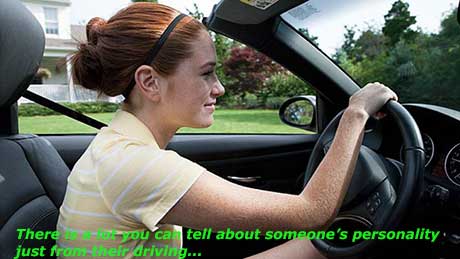
Driving and Personality
1. The impatient and restless driver
Almost all of these drivers can be seen being provocated at the slightest hint of a traffic jam or someone who cut’s in, slow or appears to be causing traffic jams. Unfortunately, these kinds of people always seem to be in a hurry and have no time for others.
2. The over-cautious driver
These people like to stay to themselves and rarely say much during a conversation and their driving is a reflection of that. Since they like solitude, going out to the open road seems a terrifying experience for them since they have no choice but to wrestle with their external surroundings. They take extra precaution to stay zealously close to what is in front of their nose as opposed to the whole environment. Their driving is unappreciated by other passengers.
3. The cool driver
You can imagine what type of personality that this driver possesses. These people are generally young and have little experience on the road. Experienced drivers will know how important it is to drive safely no matter what the personality. They are almost always not the ones that you would go into the car with since you will likely be holding tightly to your seats and giving sighs of relief from hairline misses with other cars. As you can guess, these people are probably the talkative types and loves to impress especially their opposite sex.
4. The analytical driver
These personalities are likely to belong to more mature people and often the one that you find the most comfortable being a passenger. They are not the talk of the town or go out to impress, they are very grounded, maybe boring but always grounded and gives good advice.
In the same way that you can extract personality traits through people’s driving there are other behavior characteristics that you can derive from many other activities. It’s usually a result of the fact that one cannot ‘fake’ their actions or behavior over a particular area of expertise. Take for example the people’s differences when it comes to how they handle their crockware after eating. For example, do they immediately wash up or do they leave it on the side. Do they move the other crockery out of the way without washing to do their own. There is a lot to appreciate in those types of behavior alone.
Next time when you go out on a date, try to observe their behavior in their driving, eating or doing some kind of activity, it can reveal interesting things about the person you are dating.
Tags: behavior from activity, driving and personality, driving personalities, find out person
The Rio Olympics of 2016 are filled with excitement as we see great feats of skill, strength, endurance and determination. We almost find ourselves in the same shoes as the olympian who crosses the 100m line to break the world record or the frustration of the high jumper who hits the bar on the third time.
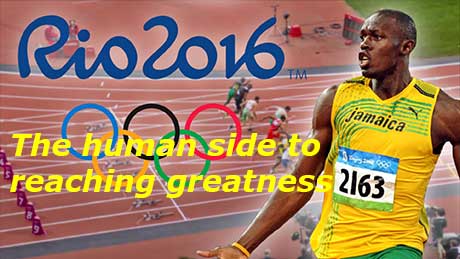
Reach greatness in your own field
I find it particularly fascinating to watch the short interviews that take place after an event, it reveals their thinking and often the purpose of why they go through such enduring hardship to reach the top. If we take mankind as a whole, we have excelled at being the masters of our world and we have a deep craving for progress and what lies ahead. This is so true for anyone who competes for a medal in the world cup.
Maybe to a lesser extent, we all have a deep sense of purpose and achievement that we strive for and the perception of how we internalize these feelings can propel us forward or keep as stagnant. We can associate all the athletes that participate in the Olympics have gone through gruelling exercise and constant practise along with much sacrifices to reach the pinnacle of their sport. Why do they do that? To many of us we cannot imagine being subject to the same constant routine day after day to just to get the satisfaction of having 1 billion people or so watching you hold your medal.
If we take that same philosophy of thinking to heart and apply it to our daily lives we should theoretically also achieve greatness in our endeavors. But many will forgo that desire to be ‘great’ because the ‘struggle’ and ‘sacrifice’ is far too much to bear in the pursuit of that goal. Nevertheless the sense of high achievement and greatness has never come without a price. But I would say to those naysayers that when you are living the dream and greatness the slog and effort that one tends to think is not the way one thinks. In fact, if those people did not ‘enjoy’ or feel ‘fulfilled’, they would not be able to maintain the path they put themselves through.
The ‘euphoria’ of living your dreams propels one to a new level of thinking where the tasks does not seem like tasks at all but inches them towards glory.
Jumpdates ThinkTank Labs
Tags: feelings, goals, learn from greatness, rio olympics, success
One can find tons of information related to the subject of finding the ideal partner. In fact, you will find many articles written about this subject on this Jumpdates blog. With the divorce rate on the rise and more people choose not to marry, these are obviously not encouraging news for anyone who want to settle down.

Married couples - east and west
The problem stems from our lack of appreciating the complexities and nuances of personalities that make up an individual. Of course when we go dating with the person, we generally don’t always see the negative side of things as both are trying to impress. This is one of the reasons why the West generally do not understand how the East can marry someone without having met them as the so called ‘arranged marriages’. The Jumpdates ThinkTank Labs have conducted some research on this subject and have come across some insightful trends and patterns that can explain some of these explicable differences.
Although we understand the nature of ‘arranged marriages’ and some may be critical about it’s practice but it is safe to say that the length of marriage would be determining factors for the match.
On the face of things it looks like the East has an upper hand on the longevity of the marriage over their Western counterparts. One should ask why this would be the case.
There are marked differing ideologies related to marriage when we compare the West and the East. Firstly, the communion of marriage between two persons in the East have a wider encompassing reach amongst members of the families. That is to say, the extended families do not move away once the marriage has taken place, in fact, they become an integral part of the future of the coupole. On the opposite side, the Western values are different where a sense of ‘space and independence’ is granted to the couple by families even though they will be still part of their lives. There are advantages and disadvantages to both of these differing family ideals and we will only touch on a few.
When couples of the East generally have trouble adjusting and coping, they can almost always turn to their family members for support. Also, in the Eastern culture, families tend to live together in a bigger household, if not, then not very far from where the couple would live. The advantage of this setup is that couples who are green in the understanding of marriage and cooperation will get a good dose of wisdom, daily checks to make their marriage successful.
The West as we know have a very different viewpoint of how marriages work and the focus is always on the couples to work things out without much outside help. As such the tensions can be high between the couple and without any obvious close support the marriage can deteriorate. Generally marriages in the West happen at later ages unless families have been an integral part of both the couples. It is difficult to say which is better than the other since they both garner human qualities which the other party would not necessarily possess. For example, the couples from the West can be more self-reliant, independent, strong and more driven to pursue their own dreams. Couples from the East may have a cooperative ability to solve problems and can be less self-preserving and look to a wider group for progress.
You the readers can decide what values can be picked from the two different cultures. Maybe a balance of the two can provide a more healthy and a longer lasting relationship.
Tags: arranged marriage, eastern marriages, marriage east & west, western marriages